
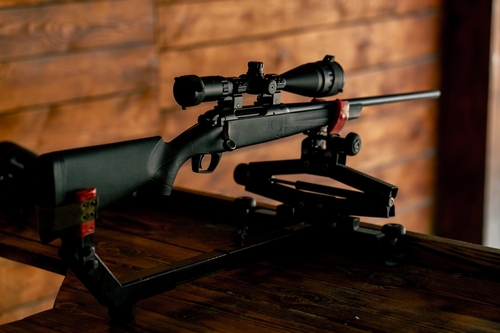
Wisconsin does not have one broad state law that simply bans every firearm commonly described as an “assault weapon.” But that does not mean every firearm, every configuration, or every type of possession is legal.
Whether possession is lawful can depend on the exact firearm, its characteristics, the person possessing it, where it is possessed, how it is used, and whether federal law applies. Machine guns, short-barreled firearms, federally regulated weapons, possession by prohibited persons, and firearms in certain locations can all raise separate criminal issues.
That is why a label such as “assault weapon” does not tell you, by itself, whether someone has violated Wisconsin law.
“Assault Weapon” Is Not One Universal Wisconsin Criminal-Law Definition
The phrase “assault weapon” is used frequently in news coverage, political discussions, and retail settings. But criminal charges are based on statutes and defined legal elements, not simply on a general label.
A semiautomatic rifle is not automatically the same thing as a machine gun. A rifle with a particular appearance may also be treated differently from a short-barreled rifle or another firearm regulated under Wisconsin or federal law.
When police seize a firearm or prosecutors pursue a weapons charge, the important questions are more specific:
- What firearm was actually possessed?
- How does the relevant statute define that firearm?
- Was the accused legally prohibited from possessing a gun?
- Was the firearm possessed in a restricted location?
- Does federal law apply?
- Can prosecutors prove knowing possession or the other required elements?
Someone facing a Wisconsin weapons investigation should focus on the exact allegation rather than assuming the words officers use at the scene accurately describe the eventual charge.
Start With The Exact Firearm And The Exact Statute
Wisconsin law has separate statutes governing specific firearm categories.
For example, Wisconsin Stat. § 941.28 addresses short-barreled rifles and short-barreled shotguns. Current law defines a short-barreled rifle generally as a rifle with a barrel shorter than 16 inches or an overall length under 26 inches, while a short-barreled shotgun generally uses an 18-inch barrel threshold or the same 26-inch overall-length threshold.
The same statute contains exceptions tied in part to compliance with federal licensing and registration requirements. Because those rules involve both state and federal law, a person should not assume that a firearm is lawful or unlawful based only on its appearance.
Wisconsin Restricts Firearm Possession By Certain People
Even a firearm that is otherwise lawful may become the basis of a criminal charge if the person possessing it is legally prohibited from having a firearm.
Under Wisconsin Stat. § 941.29, firearm possession is prohibited for several categories of people, including certain people with felony convictions, qualifying out-of-state convictions, specified juvenile adjudications, certain mental-health-related orders, and some injunctions.
A violation can be a serious felony offense.
This is why the question “Are assault weapons legal in Wisconsin?” can be misleading. A particular rifle may not be prohibited as a category, while possession of that same firearm by a particular individual may still violate state or federal law.
Someone accused of felon in possession of a firearm in Wisconsin should not assume that the state's proof is automatic. The prosecution may still need to establish the qualifying prior status, knowing possession, and the connection between the accused and the firearm.
Questions about pardons, restoration of firearm rights, or other forms of relief are especially technical and should be reviewed individually.
Machine Guns And Certain Other Weapons Have Separate Rules
Machine guns are not treated the same as ordinary semiautomatic rifles.
Federal law places machine guns within the National Firearms Act framework, and federal law generally prohibits the transfer or possession of machine guns subject to limited exceptions, including certain firearms lawfully possessed before May 19, 1986. The ATF National Firearms Act overview explains that the NFA also regulates short-barreled rifles, short-barreled shotguns, silencers, destructive devices, and certain other weapons.
The distinction became especially important after the U.S. Supreme Court's decision in Garland v. Cargill. In 2026, ATF formally removed language from its regulations that had classified non-mechanical bump-stock-type devices as machine guns under the NFA.
That change does not mean ordinary machine-gun restrictions disappeared. It means the legal classification of a specific device must be determined from the current law rather than outdated regulatory guidance.
Federal Law Can Apply Even When Wisconsin Has No Matching State Ban
Wisconsin's lack of a broad statewide “assault weapons” prohibition does not remove federal firearm restrictions.
Federal law regulates certain people, transactions, and firearm categories through statutes including the Gun Control Act and National Firearms Act.
For example, the National Firearms Act covers categories including machine guns, short-barreled rifles, short-barreled shotguns, silencers, destructive devices, and certain “any other weapons.”
Federal law also imposes firearm-possession restrictions on certain prohibited persons. Those restrictions can overlap with, but are not necessarily identical to, Wisconsin's rules.
Interstate transportation or transfer can raise additional federal questions as well. ATF explains that some NFA firearms require prior federal authorization before interstate transportation, even when the possessor is otherwise lawfully registered.
This is one reason a Wisconsin criminal defense lawyer reviewing a firearm case may need to look at both state and federal statutes.
Location And Conduct Can Create Separate Charges
A firearm can also become the basis of a criminal allegation because of where it was possessed or how it was used, even if possession of that firearm would otherwise be lawful.
Wisconsin's gun-free school-zone statute, for example, creates separate rules for possession on school grounds and within a defined school zone, while also providing statutory exceptions. Current Wisconsin law treats knowing possession on school grounds differently from possession elsewhere within 1,000 feet of school grounds.
Other criminal laws may apply to concealed carry, threatening conduct, reckless use, discharge of a firearm, or possession connected with another alleged offense.
That means the firearm's classification is often only one part of the analysis.
Local Governments Have Limited Firearm-Regulation Authority
Wisconsin also limits how far cities, villages, towns, and counties can go when regulating firearms.
Under Wisconsin's firearm-preemption statute, Wis. Stat. § 66.0409, political subdivisions generally may not adopt firearm regulations that are more stringent than state law in areas such as possession, ownership, transportation, licensing, registration, and transfer. The statute contains specific exceptions and additional provisions.
So, can a Wisconsin city simply enact its own broad assault-weapons ban?
The answer is not something to assume from another state's local ordinances. Wisconsin preemption significantly limits local firearm-regulation authority.
What To Do If Police Seize A Firearm Or Investigate A Weapons Offense
If police seize a firearm or tell you that you are under investigation, you do not need to prove your innocence during an unplanned roadside or station-house conversation.
You have the right to remain silent and the right to consult an attorney. You can exercise those rights without obstructing officers or interfering with an investigation.
Preserve any paperwork associated with the firearm, including purchase records, registration or NFA documents where applicable, permits, court records, and correspondence. Do not alter the firearm or attempt to dispose of evidence.
It is also important to identify the exact statute police or prosecutors believe was violated.
Terms such as “illegal assault weapon” may be used conversationally, but the eventual criminal charge must still be tied to an actual law and supported by admissible evidence.
Charging Labels Do Not Replace The Elements The State Must Prove
A weapons charge is an accusation, not proof of guilt.
Depending on the statute, prosecutors may need to prove facts such as:
- The accused knowingly possessed the firearm
- The item legally qualified as the type of firearm alleged
- The accused fell within a prohibited class
- The firearm had the characteristics required by the statute
- The conduct occurred in a prohibited location
- The accused acted with the mental state required by law
Possession itself can also be disputed.
A firearm found in a shared home, vehicle, room, or container may raise questions about who owned it, who knew it was there, and who actually exercised control over it.
Search-and-seizure issues may also matter. A defense lawyer can examine whether police had lawful grounds for a stop, warrant, search, seizure, or other investigative step.
Ask Singleton Law Firm To Review The Wisconsin Weapons Allegation
Wisconsin does not have one simple statute making every firearm described as an “assault weapon” illegal. But state and federal restrictions can still create serious criminal exposure based on firearm type, possession status, location, or alleged conduct.
Singleton Law Firm represents people facing weapons allegations in Waukesha, Milwaukee, and communities throughout southeastern Wisconsin.
Learn more about our Waukesha and Milwaukee criminal defense representation.
To discuss a Wisconsin weapons charge with Justin L. Singleton and the Singleton Law Firm criminal defense team, call (262)422-6578.
Wisconsin Firearm Law Frequently Asked Questions
Are AR-Style Rifles Automatically Illegal In Wisconsin?
No. Wisconsin does not have a single statewide statute that automatically prohibits every AR-style or semiautomatic rifle simply because of that label.
Legality can depend on the firearm's actual characteristics, whether it falls within another regulated category, the status of the person possessing it, the location, the conduct involved, and federal law.
Can A Felony Conviction Affect Firearm Possession?
Yes.
Wisconsin Stat. § 941.29 prohibits firearm possession by people in several specified categories, including many people with felony convictions.
Whether rights have been restored or an exception applies requires an individualized legal review.
Are Machine Guns Treated The Same As Ordinary Semiautomatic Rifles?
No.
Machine guns are subject to separate federal restrictions and National Firearms Act rules. The federal definition and regulatory framework should not be confused with ordinary semiautomatic operation.
Can A City Create Its Own Assault-Weapons Ban?
Wisconsin's firearm-preemption statute significantly restricts local governments from imposing firearm regulations that are more stringent than state law in covered areas.
Because preemption and local ordinance questions can be fact-specific, any actual local restriction should be checked against Wis. Stat. § 66.0409 before conclusions are drawn.